Article content
In briefShow moreShow lessContact Center in Dynamics 365 brings together customer interactions across phone, email, chat, SMS, and social media in a single platform.
- Contact Center in Dynamics 365 brings together customer interactions across phone, email, chat, SMS, and social media in a single platform.
- The IVR bot and Copilot Voice are configured in Copilot Studio as a low-code solution that can be used for both voice and chat.
- The telephony solution uses Azure Communication Services and can connect to an existing telecom operator via a bridge provided by partners.
- The IVR bot can identify callers by phone number and retrieve and update cases (incidents) in Dataverse through Power Automate.
- When the conversation is transferred to an agent, the agent receives the transcript, the selected menu option, and the updated case history directly in the interface.
With Contact Center integrated into Dynamics 365, customer service agents can manage all interactions across multiple channels. Whether inquiries and follow-up take place by phone, email, live chat, SMS, or social media, everything is brought together on a single platform. This means better workflows for contact center employees and a seamless, positive experience for customers.
Join the live demo and learn:
- What is Contact Center?
- Demo: Copilot Voice
- Set up an IVR bot
You can watch the webinar on our YouTube channel
Here you can read the transcript of the webinar held on October 22, 2024:
How to set up an IVR bot for telephony
Frode Stenstrøm: You may have found yourself waiting on hold, frustrated by the long wait and wishing there were a smarter way to get help. What if your customers could get answers quickly and efficiently without having to wait for an agent? In today’s webinar, where we will discuss Microsoft’s contact center solution, Dynamics 365 Contact Center Voice, you will see how artificial intelligence can be used to answer your customers’ questions, freeing up your agents’ time so they can focus on more complex cases.
IVR is an English abbreviation that stands for Interactive Voice Response and is used by the vast majority of contact centers. We will now take you through the entire process, from setting up a basic IVR bot to seeing it in action. Imagine a busy customer service department where your cases come in through multiple channels, such as phone, chat, and social media.
The contact center solution brings all these interactions together in one place. An IVR bot can help you automate the initial steps of the process by routing and sorting calls according to each customer's needs. At the same time, your agents get a clear overview of the interactions taking place across all platforms.
So stay tuned as, later in today’s broadcast, you’ll set up your first IVR bot, either integrated with an existing CRM solution or as a standalone solution that enables you and your company to provide even better customer service.
Welcome to the demo
Frode Stenstrøm: And with that, I’d like to welcome you, Kristian.
Kristian Nadim: Thank you, Frode.
Frode Stenstrøm: First broadcast.
Kristian Nadim: Yes, it is.
Frode Stenstrøm: This will be fun. And Kristian, you’ve worked with this—you’ve used it in practice.
Kristian Nadim: Yes, I've set it up for a few customers, given a presentation on it before, and tested it. It works in English, at least, as we'll see later today, but it remains to be seen how well it works in Norwegian.
Frode Stenstrøm: That's right. Kristian, we had a broadcast here in early summer where Emil, our colleague, demonstrated many of the same solutions. I would say that the technology has advanced considerably in just the past few months. So we thought we would take the opportunity today to show you some of the new developments, how modern the technology has become, and what is now possible.
But we’re also just as honest about the things that don’t work. And Kristian, apart from the fact that you work here, what else is there to say about you?
Kristian Nadim: No, not that much. I work as a team leader and senior consultant here at ProsessPilotene. I’ve been working here for almost four years now.
Frode Stenstrøm: It will be ten years.
Kristian Nadim: Yes, it will be ten years by Christmas.
And I work a lot with customer service here, and I’m very passionate about customer service, especially telephony. At the other places I’ve worked, telephony and chat have often ended up outside the CRM solutions themselves because they don’t come with ready-made solutions like Microsoft’s contact center does now.
Frode Stenstrøm: My name is Frode, and I’ll be today’s host, guiding us through the broadcast, which, as usual, is streaming live on YouTube. Feel free to ask Kristian questions now, or after the broadcast by leaving a comment below the video. We’d love to know who you are, so if you’re watching now, please say hello.
And as usual, we add chapters and captions to the recording so that you can watch the exact part of the broadcast that is most relevant to you and your organization. While you're at it, like and share, and turn on notifications. We'd also like to remind you about the Process Podcast, which you can find here on YouTube and wherever you listen to podcasts. There, you can hear more about strategic issues, and our latest episode featured an interview with Moelven about how to manage internal communications and leadership development.
Agenda for the broadcast
Frode Stenstrøm: So, Kristian, a little about today's agenda.
Kristian Nadim: Yes, first I’ll briefly explain what a contact center is and what we’ll be focusing on today. Then I’ll run a live demo of Copilot Voice, where we’ll look at some of the features available today and hope that it works really well.
And then I’ll explain a little about what an IVR bot is, which Frode touched on earlier. Then we’ll try to set up a bot using an existing connector that Microsoft provides out of the box, so we can see if it works right away.
Frode Stenstrøm: So, Kristian, the first thing we need to do now is address the first point and simply set up a landscape.
And so those of you at home have been given a bit of a warning. The diagram we have now is a big one, but I expect you'll be guided through it. So let's dive into this one.
Overview of Microsoft Contact Center
Kristian Nadim: Yes, this is the entire Microsoft contact center environment, where you can see all the channels under number 1 here, including Voice, SMS, email, and so on.
Today, we will focus on Voice. Microsoft uses a technology called Azure Communication Service, which allows you to connect your telephony service so that you can receive all your phone calls. For example, you can bring your own telephone operator to connect to the service. What we will be discussing most today is shown in box 4: Copilot Studio.
This is where you set up your Copilot. It can be the same for both chat and voice. This is what we will focus on today, and it will assist further by both routing and passing the information on to the agent who receives the call in box six here. In addition, we will also look at how Copilot can retrieve data from Microsoft Dataverse via, for example, Power Automate.
There is also much more to explore here, but today it makes sense to focus on Copilot Studio.
Frode Stenstrøm: But I think it’s interesting, Kristian, because we’ve seen that Copilot Studio essentially started out as a chatbot, and then they’ve built a great deal of automation into it, and it’s not really a development tool.
Kristian Nadim: No, it’s very low-code, so I would also say today that you can set up and try most of this yourselves, and it’s very quick to get started and test whether it works or not, and we’ll also show that today. And now you can, of course, also use Copilot to set up what Microsoft calls topics, so that you can bring up the different...
Frode Stenstrøm: But you told me before the broadcast, Kristian, that there are some updates regarding the agent experience. We won't talk much about that today, but a lot is happening in terms of what it's like to receive these inquiries?
Kristian Nadim: Yes, Microsoft has released several, so you can set up Copilot agents based on different types, for both sales and service.
There was a rollout yesterday, or an announcement from Microsoft yesterday, but we haven't had a chance to look at it closely enough yet.
Frode Stenstrøm: So there’ll be a webinar soon, then—another broadcast.
Kristian Nadim: Maybe
Frode Stenstrøm: Yes, but it’s incredibly exciting. What I also find interesting about these things is that it’s a question I’m often asked. You may touch on it today, Kristian, but the telephony solution will play a part in how we address it, because this is...
All customers wonder whether they need to switch telecom providers, and how do you do that?
Kristian Nadim: Yes, you don't need to switch telecom operators. You simply set up what is known as a bridge between Azure Communication Service and your existing telecom operator, whether that's Telia, Telenor, or whichever one you use, and you can set up a bridge through it.
And it works through several partners in Norway today that provide this bridge for you to use.
Frode Stenstrøm: No, but that's good. So we've gone through the entire infrastructure, and what you're going to show is the voice part that uses that communication service, routes it, and copies it, if I understand correctly.
That's the part that actually does the work. And that's where you have artificial intelligence, right?
Kristian Nadim: That’s where we use a bit of artificial intelligence, which can then route it to the right agent or the right queue and pass along all the information the customer has provided to the bot.
Frode Stenstrøm: Emil and I held a webinar a few weeks ago where we talked about using artificial intelligence to create and organize knowledge articles. Since they are stored in the same database, you can also use them for telephony and voice.
Kristian Nadim: Absolutely
Frode Stenstrøm: But then we'll move on to the next reading here, and that's this one.
Live Demo: We Test Copilot Voice
Kristian Nadim: Yes, so I'm going to take out my phone and then I'm going to call... the Environmental Pilots
Frode Stenstrøm: Our little demo company, Miljøpilotene, doesn't actually exist, of course
Kristian Nadim: Of course, it doesn't exist, so what I'm doing now is calling a number
Frode Stenstrøm: A Norwegian number
Kristian Nadim: a Norwegian number, and this one will probably come through soon
MiljøPilotene IVR-bot: Hello Christian Thank you for calling Environment Piloting Phone
Kristian Nadim: And the first thing you just heard was that this Copilot knows who I am. That is because I am calling from my number, and it has looked it up in the database. Since that number is unique, it knows that it is me.
So, as you can see in that message text, I've set it up to retrieve the customer's name and say that it's nice to speak with you.
Frode Stenstrøm: If you want to take it further, that right there makes a big difference, because most people who call customer service have no idea who you are.
Kristian Nadim: No
Frode Stenstrøm: Ideally, you might have a pop-up function that brings up the customer card, but you always have to give it some thought.
Kristian Nadim: Yes.
Frode Stenstrøm: Okay.
Kristian Nadim: So the next function here now,
Is that there is something called a question set here. So here, for example, you have many different questions we can ask. In addition, you can see these keypad numbers that you can use, as well as just speaking normally.
Frode Stenstrøm: Because that's what most people are used to: Press 1, press 2, press 3, and press 9 for English, for example
Kristian Nadim: Yes, and under each of these—like where it says Microsoft Dynamics CRM here—you can add various other words that can trigger it to continue down that path.
Frode Stenstrøm: So the words you've written now are the words that the bot will now understand you by?
Kristian Nadim: Yes, that's right.
Frode Stenstrøm: I see it's waiting patiently. You've muted it, and it's still on.
Kristian Nadim: Yes, we'll see. Maybe I've been transferred to an agent, who knows. Yes.
Microsoft Dynamics CRM
MiljøPilotene IVR-bot: When you start the Microsoft Dynamics NAV Windows client or the Microsoft Dynamics NAV web client, a connection is established with the Microsoft Dynamics NAV server instance and a corresponding session is added on Microsoft Dynamics NAV server What can I help you with today?
Kristian Nadim: So, what you just saw was that the data source is the next page. Here, I selected it, so it uses a general response from the data source I set up, which in this case was Microsoft.com. So it is very general, which is why you get very different answers each time you ask. But in principle, you can use any website here; you can use a SharePoint site, a Word document, or all sorts of other things.
Frode Stenstrøm: In principle, it could have been the built-in knowledge base in Dynamics.
Kristian Nadim: So this is just an example to demonstrate. You can use basically anything, and the bot's response is completely random. It varies a little from one time to the next.
Frode Stenstrøm: But isn’t that how generative AI works in general—that it tries to give you what it thinks you’re most likely to want to hear based on the available data?
Kristian Nadim: Yes, it does
Frode Stenstrøm: So it’s not necessarily a verbatim answer?
Kristian Nadim: No, it isn't.
Updating cases - incidents
Kristian Nadim: So that's that feature, and next I thought I'd demonstrate the advantages of it being connected to Dataverse, allowing you to find out how many—for example, in this case, I'll check whether I have any incidents or cases assigned to me.
So, we can move on.
Frode Stenstrøm: New demo.
Kristian Nadim: No, I’m just passing it on.
Frode Stenstrøm: This one?
Kristian Nadim: Yes. So do I have any...
MiljøPilotene IVR bot: Can help you with today?
Kristian Nadim: Do I have any incident?
MiljøPilotene IVR-bot: We found the following active incident on you. My apartment is flooded. Would you like to update your following incident? My apartment is flooded.
Kristian Nadim: Yes.
MiljøPilotene IVR-bot: What would you like to update?
Kristian Nadim: This is a live demo.
MiljøPilotene IVR-bot: Your incident my apartment is flooded has been updated with the following information. This is a live demo. You will now be redirected to the main menu.
Kristian Nadim: So, we have now updated CRM simply via an action and a Power Automate flow, which first finds me, then finds and lists all the incidents I have, and then goes back and updates what I have done.
So the agent itself doesn't actually have to do that job; the bot does it for us. And again, this is low-code, very straightforward and easy to set up.
Frode Stenstrøm: Kristian, for those who aren't familiar with Power Automate, can you explain what it is?
Kristian Nadim: It is an action that you can perform to retrieve and update information in Dataverse or in the database. And it has many connectors.
Frode Stenstrøm: There are indeed many. I find it quite exciting because I believe that Power Automate can also be used for a great deal of case automation, especially in the customer service center.
Kristian Nadim: Absolutely.
Frode Stenstrøm: And the great thing about putting it on the Copilot platform is that you can also use it for a My Page solution. You don’t have to use it just for telephony.
It's really a universal tool.
Kristian Nadim: Absolutely.
Frode Stenstrøm: But that was kind of cool, because then I saw that you were validated and the cases were updated without anyone talking about it any further.
Transfer to agent and conversation history
Kristian Nadim: Yes, and then I thought I’d show you the last one, which is transferring someone to an agent. We can then include the entire conversation history and everything that happened via the bot during that session.
And let's see, hopefully that works too. Can I report an incident please?
MiljøPilotene IVR bot: We found the following active incident registered to you: My apartment is flooded. Would you like to update this incident? My apartment is flooded.
Kristian Nadim: No, thank you.
MiljøPilotene IVR-bot: You will now be redirected to the main menu. What can I help you with today?
Kristian Nadim: Report incident.
MiljøPilotene IVR bot: What type of incident do you want to report? You can press 1 or say invoice, and press 2 or say product.
Kristian Nadim: Product.
MiljøPilotene IVR bot: Okay, we will transfer you to an agent. Please hold.
Kristian Nadim: So there I also showed an example of... You can also have keypad options, and having it read out all the options in the menu is another possibility—there's a setting for that as well. So it depends somewhat on how you want to present this. And now we're fortunate enough to be able to move on, Frode.
Frode Stenstrøm: Now I'm going to switch over to the screen. The one that ...
Kristian Nadim: Perfect.
Frode Stenstrøm: Wait, I need to put it on the one that ... I went one too far, like that. Sorry. There!
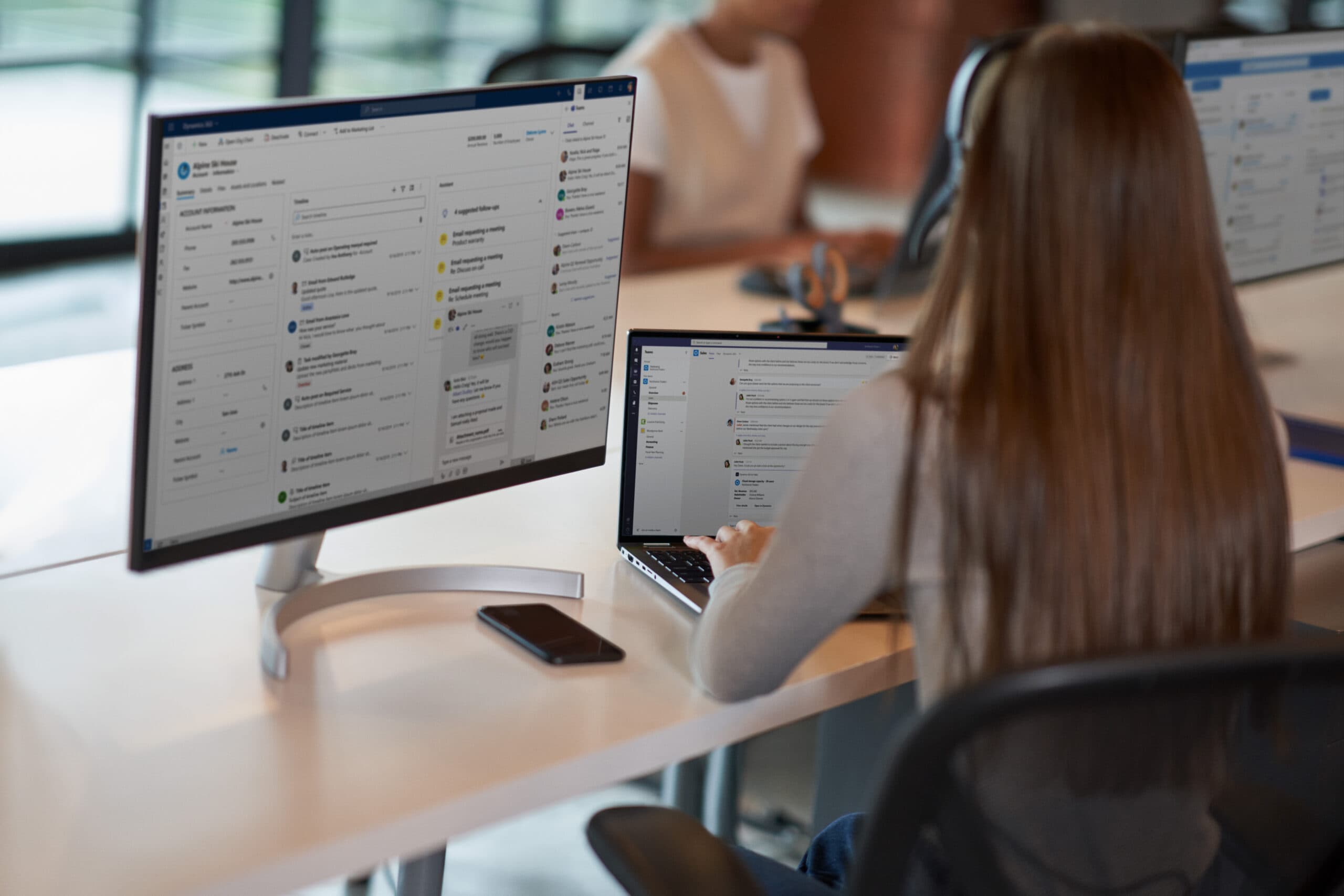
Kristian Nadim: Great. So now you can see that I, as an agent, have received the phone call here and need to accept it.
Frode Stenstrøm: It’s live, so there’s no trickery involved.
Kristian Nadim: And here you will now see the entire transcription that has been done.
Here is the answer we got in the first one with Microsoft Dynamics CRM.
Here you can see the following active incident: my apartment is flooded, and what I was going to do—this is a live demo—let's see if it was updated. Here is my problem, and down here I've asked someone to update it. This is a live demo, so it definitely worked.
Frode Stenstrøm: Yes, I have to say that compared to what we showed this summer, when the technology was still, you might say, at the pre-rollout stage, an enormous amount has happened
Kristian Nadim: Yes, at least it works.
Frode Stenstrøm: Yes, that's good.
Kristian Nadim: Yes, then you will also... Be able to see everything that exists, and in addition, the last one I included—here you can choose what they selected in the option set, so here I have requested that it include the fact that I selected product.
Frode Stenstrøm: Yes, so the agent knows what you're looking for before you've actually spoken to each other.
Kristian Nadim: Yes, and here you can add more information if you need to, and as you can see here now, yes, it’s doing something while we’re typing here. So now, if I add this here,
Frode Stenstrøm: Yes, you just saw that.
Summary of Copilot features
Frode Stenstrøm: Those of you at home can't see it, but he hung up the phone, and I saw that on the screen too, so that's correct.
Kristian Nadim: Yes, and then we get a complete summary from Copilot, which can then be used going forward and copied, or you can create a case if needed.
And now all... Everything from this conversation will also be linked to both the person and, in this case, the case.
Frode Stenstrøm: If the person is linked to a company, will you also add the history to the company?
Kristian Nadim: Yes, so here you have everything. And it really depends on how you want it. But here you'll see all the numbers and calls, so you can see that I tested it a little earlier to make sure it worked.
Customer Voice for surveys and NPS scores
Kristian Nadim: And after this, you might want to conduct a survey or have... Something along those lines, and then you can set it up using Customer Voice and send out a survey to measure how satisfied people are, using an NPS score or similar metrics.
Frode Stenstrøm: Could you build the bot to call the customer, ask whether they were satisfied, get a yes-or-no answer, and simply end the call?
Kristian Nadim: You can do that too.
Frode Stenstrøm: Instead of having that awful press 1, press 2, press 3.
Kristian Nadim: Yes, you can also set up a bot afterward that makes outbound calls for you.
Frode Stenstrøm: Exactly.
Kristian Nadim: So it’s starting to get really, really good and works very well.
Frode Stenstrøm: I can see that. It’s absolutely wonderful for a customer service center that handles a high volume of calls to have these phone conversations summarized and documented in this way.
Kristian Nadim: Absolutely. And they will also be available here as transcripts that you can read through and review later if needed. So, that was really what I had planned to show you of the existing bot.
Frode Stenstrøm: No, but that was really exciting. I'm sitting here thinking—there are a lot of thoughts running through my head right now—because it seems deceptively simple. There are quite a few nuts and bolts working behind the scenes to make all of this come together. But customers who want to get started can really just talk to you.
Kristian Nadim: Yes, they can just do that.
Frode Stenstrøm: But do you find that setting up something like this, a demonstration like this, is a lot of work?
Kristian Nadim: It’s very straightforward. Setting this up is very quick. Connecting telephony and getting a solution up and running is relatively straightforward, without too much configuration. What does take a little time is teaching these superusers how the system works so they can start using and managing it themselves.
Frode Stenstrøm: Exactly. But then, I know you were going to show us more
Kristian Nadim: Yes, we will So
Frode Stenstrøm: I'll switch over to that, I just need to do this
Demonstration of IVR and voicebots
Kristian Nadim: So, what we've just looked at is a customer calling in, and we've used what's known as IVR or voicebots. All these bots can be connected to all the channels you see here, and you can use the same ones and set them up one at a time. Again, that's the one you need to train, and it's what determines where you go next.
So that's part of the idea, and in addition, these Copilots have many ready-made connectors
available for integration with third-party systems
Frode Stenstrøm: Yes, there are many.
Kristian Nadim: I don't remember how many. Then, as I'll show you later, you can, for example, connect to other systems that you can retrieve information from and provide to your customer.
Frode Stenstrøm: What I find exciting about this is that we at Prosesspilotene have launched a standard web portal, a My Page customer service portal, which also uses this same database. And that means that in the portal, whether you chat with someone there or pick up the phone, you can essentially start with the chat and continue the conversation.
And you don't have to start over, because that's what's frustrating for the customer: having to start over and explain what the problem is. For the umpteenth time.
Kristian Nadim: And everything carries over, even if you speak to the billing department first, then the product department, and finally the sales department—you still have the entire conversation history with you.
Frode Stenstrøm: Yes, it’s very tiring. Okay, but we’re going to set up the boat—is that what you were going to do now?
Kristian Nadim: Yes, we're going to try connecting to a third-party solution. So, let's see if it works.
Frode Stenstrøm: Let me see, there. I'll just go over there, like that. Yes, yes. Let's see, there.
Kristian Nadim: So, what you saw earlier—let's see, I can start here. We are now in Copilot Studio.
Yes, here we have a bot that has connected to a knowledge article on Microsoft's website. And that copilot contains a great many topics. Topics are how you categorize what needs to be done. And the one we looked at was called main menu, in other words, the bot's main menu. And it had a lot of questions here. And if you take a closer look at it, it's set up so that if I select Microsoft Dynamics CRM, I move on over here.
Frode Stenstrøm: To its branch, yes.
Kristian Nadim: That one, and then the artificial intelligence comes down here.
Frode Stenstrøm: So this is a graphical representation of what you would often see in a standard contact center solution, where you route the calls based on 1, 2, 3.
Kristian Nadim: Exactly the same. And I've set up five of them here, and the only one I've configured here right now is for “Weather.”
Because it's missing something; it only has one condition, but nothing actually happens with it.
Frode Stenstrøm: Yes, you've only said that it can respond, but it doesn't.
Kristian Nadim: It doesn't answer, so it just exits and starts over again. So what would be cool to get working now is for me to set it up to connect directly to a weather forecast.
Frode Stenstrøm: That's good. We did say in the introduction that we would show how we build it.
Kristian Nadim: Yes, so Microsoft has called these actions in Norwegian. Here you can add actions, and once again you'll recognize a lot of the familiar elements from Microsoft's low-code platform, with various options. The one we thought we'd try is called MSN.
So, it’s called Get today’s weather forecast. Or you can have one called Get current weather forecast for today. And as you can see now, there’s a connector to the MSN Weather website that’s already set up. All you really need to do is click Next. Then you can decide what the input data should be and what output data you want, and as you can see here, you get a lot of output data out of the box.
Perhaps not all of that information is relevant. For example, you may not be particularly interested in the current phase of the moon.
Frode Stenstrøm: So, should we put on rain gear like that, or not? Of course, some people will want the moon phase too.
Kristian Nadim: Yes, so here you can basically just click ... Edit and delete the things you're not interested in.
And when you're happy with the ones you want, you can just click Save, and then we now only have 30, in a way. And when that's done, you click Next and Finish, and then Microsoft basically does the rest of the work, retrieves the Connect, and adds it to the menu for it...
Frode Stenstrøm: For that flow, yes. And if you're missing any data connectors you need, we at Prosesspiloten can create them. We have a webinar on exactly how to get your own data into Copilot. Admittedly, it's almost a year old now, but the same principle still applies.
Kristian Nadim: That's right. And here, I have this condition here, so I can go in and invoke an action, I believe it's called.
Frode Stenstrøm: A good Norwegian word
Kristian Nadim: Yes, and get forecast today, and you click there, and then it appears here, and it is already set up with all the elements that could be added to the 30-item figure. Here, you also have the option to remove anything you do not need. And if you do not need all of these, you can remove them while you are on them.
Frode Stenstrøm: You only get what you need, yes.
Kristian Nadim: And then you just save it, and then it’s basically ...
Frode Stenstrøm: Has it been changed?
Kristian Nadim: If it has been changed, then I got an error message, of course. And there are many such functions, and here you can connect several variants.
Customizing the bot's speech and functions
Kristian Nadim: Another useful thing to know about this Copilot, as you may have noticed, is that some of these bots speak a little differently, and sometimes you can ask them to speak a little more slowly if they are speaking too fast, and so on.
So here you can add your own pauses, different sounds, and emphasis on words, so you can make it speak more naturally if you need to.
Frode Stenstrøm: Wow, I didn't know that. That's really great.
Kristian Nadim: So here you can sort of specify that you want emphasis, if you have both. Whether it should be emphasis Strong or Medium or whatever you prefer.
So again, you can control how the text is presented and how your bot speaks. And again, you can simply click Test here. That doesn't work with Voice, so you'll need to save and publish it and then call in, but you can always use the chat functionality to test it before you launch. And that works really well.
Frode Stenstrøm: And that was also changed about a year ago. Initially, there was a chat there that was left over from the old chat project. But the testing has gotten much better now.
Kristian Nadim: Yes. Another exciting feature is the knowledge I mentioned. Here you can add knowledge. You can use a public website, SharePoint, Dataverse, or files that you can drop in and add, which Copilot can then use to answer questions. So those are the knowledge sources available to you.
Frode Stenstrøm: And what you're showing right now, Kristian, is highly relevant to some of our customers. I know they have often documented procedures and routines in a Word document. And the questions customers ask don't necessarily have just one question and one answer; the answer may be compiled from several articles.
And previously, we had to build this at the foundational level in Azure Studio. Now we can build it directly there, making it visible to the agent as well.
Kristian Nadim: Yes, so this is working really well now too. There’s a lot of new functionality being added all the time, so you just have to keep up and try to stay on top of what’s happening.
It's not always that easy.
Frode Stenstrøm: No, it isn't, but I think it's good that things are progressing. About a year ago, when we started holding the first webinars on Copilot and that sort of thing, we said that we didn't believe it would come to Norway before May or June. Then Microsoft announced that Copilot would arrive in February, and quite a few people got access to it.
But it’s only now that we’re starting to be able to use it, and that our customers have adopted it. So it’s good that it has matured.
Kristian Nadim: It is.
Frode Stenstrøm: So, we've talked about that. We were also going to talk a little about what an IVR bot is, weren't we?
Kristian Nadim: Yes, we were.
IVR bot and smart routing
Kristian Nadim: For those of you who aren't familiar with the term, an IVR bot is something that can help you automate the types of inquiries we've just seen examples of.
This was an example involving a case. I think that placing an order or ordering a product by phone are also things that can be automated, saving customer service resources. There are lots of inquiries that currently take up a lot of time on the phone and are highly standardized. You can streamline call handling; the bot knows who it should talk to or which agent to use, so you can use Smart Routing, which is now a feature in Microsoft's contact center and is based on what the customer wants.
Then you can route this not only to the right department, but also to the right agent, which is useful.
Yes, you can improve the user experience for the agent or the customers. And I think that's great, because as things are today, these menus are read out to you over and over again, and there are a lot of menus, and you have to make a lot of keypad selections before you get the answer you need. Now you can make this much more efficient and save the customer from having to make so many keypad selections.
Frode Stenstrøm: And what you're saying there is one of the really great things: you can say what you want in a single sentence, and then hopefully you'll be directed to the right place ... I've called customer service, navigated through five menus, realized I'd reached the fifth menu and had to start over. If I was annoyed before the call, I'm certainly no less annoyed afterward.
Kristian Nadim: No, so in principle, we can eventually move away from those keypad options and simply say what we want, and then the IVR bot can help the customer service center find the right agent and the right department for it. So that is the future.
Frode Stenstrøm: Yes, good. Were you going to show us anything else, Kristian?
Kristian Nadim: No, I think I'll leave it at that.
Frode Stenstrøm: Oh, so you're done. Yes, well, that's very, very good. I thought I'd check whether there was anything... I have a few questions for you that I was wondering if you could try answering, because they're things I know our customers have asked about.
The solution is stand-alone
Frode Stenstrøm: The contact center solution for Microsoft—do you have to be part of the Dynamics ecosystem to get it, or can you buy it as a stand-alone solution if you're a Salesforce customer?
Kristian Nadim: It is a standalone solution.
Frode Stenstrøm: Yes?
Kristian Nadim: Yes.
Frode Stenstrøm: So you don't depend on anything else?
Kristian Nadim: No
Frode Stenstrøm: Okay. And regarding telephony, you touched on that—you have some experience with who in Norway facilitates telephony, so you know how... Could you tell us a little about that?
Kristian Nadim: Yes, what we have used a lot is CTELO. They are very skilled and knowledgeable in this area.
And they have helped us a lot with setting things up for our customers, so that’s been really good.
Frode Stenstrøm: So they’re the ones who make sure you get a dial tone, ringing tone, and things like that?
Kristian Nadim: They are the ones who route the call from Telenor or Telia into Azure Communication Service.
Frode Stenstrøm: Yes, that's right, right, right. Yes, but that's an interesting question. And then there's this: you've now shown a bot that essentially answers questions, and it performed an update. But that also means the bot isn't just one-way.
You can actually use it to do things. So, in principle, you could use it to sell tickets and carry out sales and sales transactions.
Kristian Nadim: Absolutely, you can basically update or do whatever you want in that system.
Frode Stenstrøm: But that system is also for external systems, right?
Kristian Nadim: Yes, then you need a connector or an integration through it.
Frode Stenstrøm: Yes, but it’s still possible.
Kristian Nadim: Yes.
Frode Stenstrøm: So, another question I've received from the customer, which you touched on briefly: Is getting started a major project? Or are we talking about days, weeks, or months to get up and running?
Kristian Nadim: No, installing and setting up a call queue takes about a week.
Frode Stenstrøm: Yes, and then you're done.
Okay, if there are any other questions from those watching at home, please feel free to take care of them, but I only covered some of the ones I know about and that they have sent us. But Kristian, I think I'll look into that a little. There aren't any questions, so let's just do a recap.
Summary and conclusion
Kristian Nadim: Yes, we’ve talked about Microsoft’s contact center, which was rolled out this summer, and they’ve really invested in it, so it’s a very exciting product. And as we said earlier, it’s a standalone product. You can use all channels to connect to the contact center.
So that will be really good. You saw a demo of Copilot Voice. Feel free to show it to others if you need a separate demo. We talked a little about how an IVR bot can contribute and help, and then looked at a quick setup of an IVR bot, where you get some topics out of the box and can then configure or customize the bot however you like.
Frode Stenstrøm: Yes, and with those words, I would like to say thank you very much, Kristian, for your contribution to today's broadcast. If you have any questions, just leave them in the comments section below the YouTube video. And please feel free to share it with your colleagues. If you would like more professional content, you can subscribe to our YouTube channel and follow us on LinkedIn.
The broadcast is available on YouTube and on the website prosesspilotene.no. The broadcast is produced by Prosesspilotene, which increases the value of your customers through the use of Microsoft technology. I, Frode Stenstrøm, have been today's host, and Oddbjørg Berge is the project manager. And stay tuned next week, when there will be even more exciting webinar broadcasts from this studio. Kristian has now actually promised to show you the latest feature in the agent experience.
It's always fun when you come to the studio, you know. Wishing you all better work processes. See you again.
Dynamics Contact Center is a useful tool for any organization or business looking to improve its customer service. The solution is designed to enhance the customer service experience through advanced tools and features that give customer service agents the resources they need to handle customer interactions efficiently and personally. In addition, the solution gives businesses better insight into customer service performance and makes it easy to adapt to growth and change. New! Contact Center is now also available as a standalone app and can be integrated with other CRM systems.
Contact us for a demonstration.