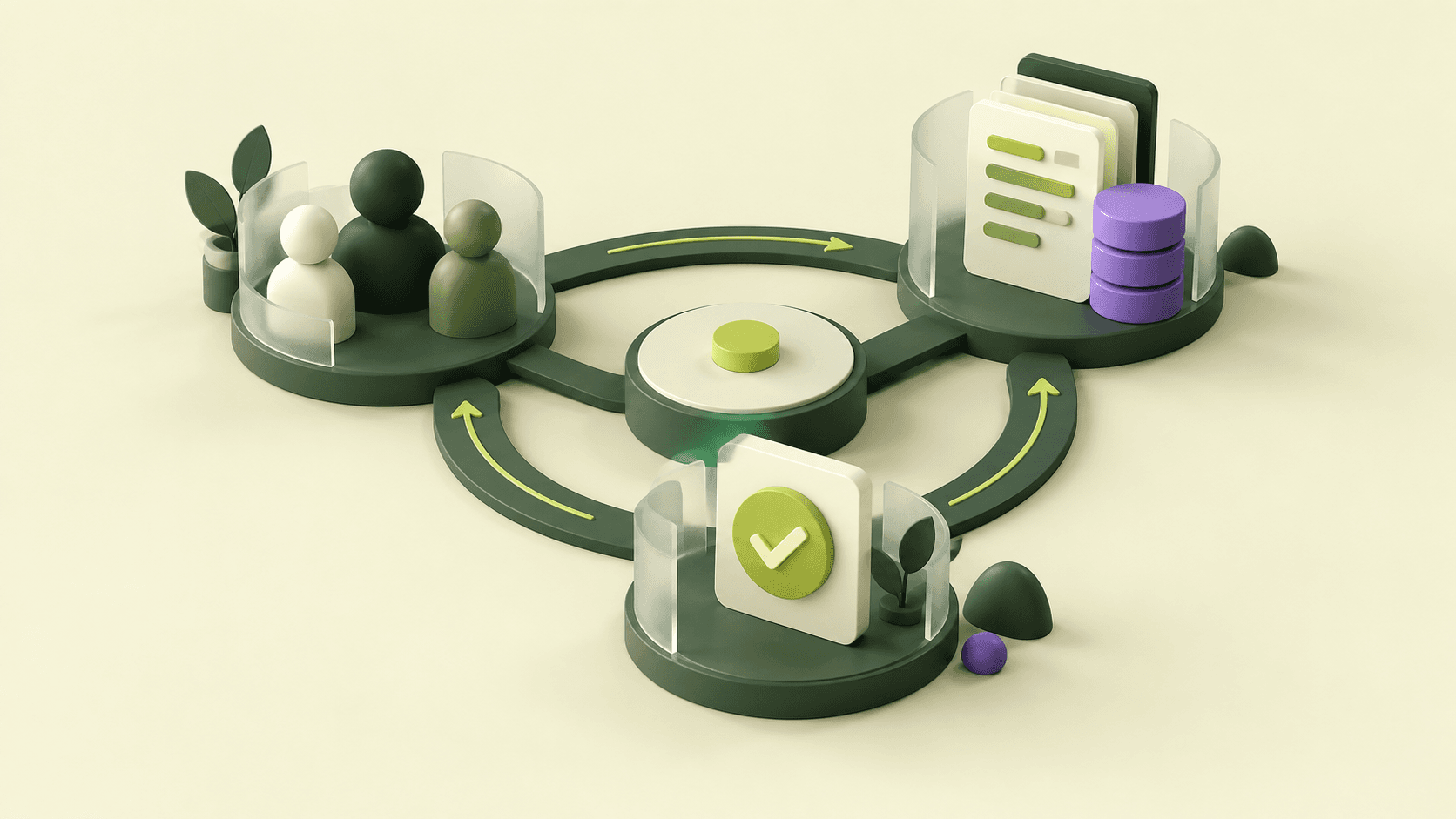
How do you lead a project team from planning to customer acceptance?
Created with AI.

Use this guide to establish the project's working agreement and maintain it through delivery. Help contributors act independently within clear boundaries and obtain customer decisions in time.
Continue in the business-area learning path
- 6 steps
- Total time: 45 min
- Preparation: 10 min
- Result: A project-management rhythm covering ownership, forecasts, change decisions and acceptance.
Required tools
- Worksheet and approved business application — Practise locally with fictional data. Apply changes in your work only within your agreed role and organisation's routines.
Working routine
1.Establish the working agreement
Agree objectives, scope, deliverables, acceptance and decision roles with the customer and team. Include exclusions. Verify sales assumptions and assign owners to unresolved promises.
Do this and check the result
Create one overview linking the current agreement, plan, decision log and change process. Agree how the team finds the correct version.
2.Plan feasible capacity
Connect milestones to specific deliverables and required skills. Confirm actual availability with the resource manager. Expose dependencies and account for uncertainty.
Do this and check the result
Ask each delivery owner to explain the estimate, assumptions and verification method. A name on a plan is not a confirmed resource commitment.
3.Manage through forecasts and decisions needed
Review actual effort and remaining work together. Ask for evidence behind status and remove obstacles. Summarise changes, consequences and what you need from the customer.
Do this and check the result
Practice case: 70 hours spent and 50 remaining mean 120 forecast hours. Show budget deviation, explanation and alternatives; do not report green only because the milestone date is unchanged.
4.Make changes deliberate decisions
Describe the change and its effects on time, cost, quality and other deliverables. Present options to the correct decision owner. Record the decision before changing the commitment.
Do this and check the result
Write a brief decision with the chosen option, rationale, revised plan and communication owners. A rejection must also be understandable to the customer.
5.Plan acceptance and handover early
Agree how the customer will test the outcome and what acceptance means. Allocate open items and operating responsibilities before closure. Allow knowledge-transfer time and review improvements for future projects.
Do this and check the result
A sound closure record shows accepted deliverables, owned open items, support arrangements and a planned check of benefits after handover.
Further reading
6.Official product context
The working routines and fictional examples above are ProsessPilotene learning material. Use the official product documentation below for product context; availability depends on your organisation's setup.
Discussion
Ask a question or share what helped you.